Choosing the best Electric Balloon Pump starts with understanding the real demands of your event. A home birthday party needs different equipment from a wedding decorator or a busy rental business. Grand View Research describes the global party supplies market as a multibillion-dollar industry, showing the scale of balloon decoration and event preparation. However, market growth does not guarantee that every pump offers reliable performance.
Speed matters, but it is not the only measure. A useful pump should inflate common latex balloons quickly, provide compatible nozzles, and resist overheating during repeated use. Check the stated airflow, motor duty cycle, noise level, power method, and warranty terms. A pump that fills a balloon in seconds may still disappoint if it becomes hot after ten minutes. Small details matter. The nozzle should feel secure. The power cord should reach the work area. For mobile decorators, a rechargeable battery can reduce cable clutter.
Safety and build quality deserve careful attention. Look for clear instructions, thermal protection, stable housing, and recognized electrical compliance marks suitable for your market. Consumer safety guidance from organizations such as the U.S. Consumer Product Safety Commission emphasizes responsible product use and keeping electrical equipment away from unsuitable conditions. Customer reviews can reveal practical issues, although they are not controlled laboratory tests. No pump is perfect. Some manufacturer claims are difficult to compare fairly. The best choice balances speed, durability, sound, portability, and price against your actual workload. A thoughtful buyer measures the work, not just the advertisement.
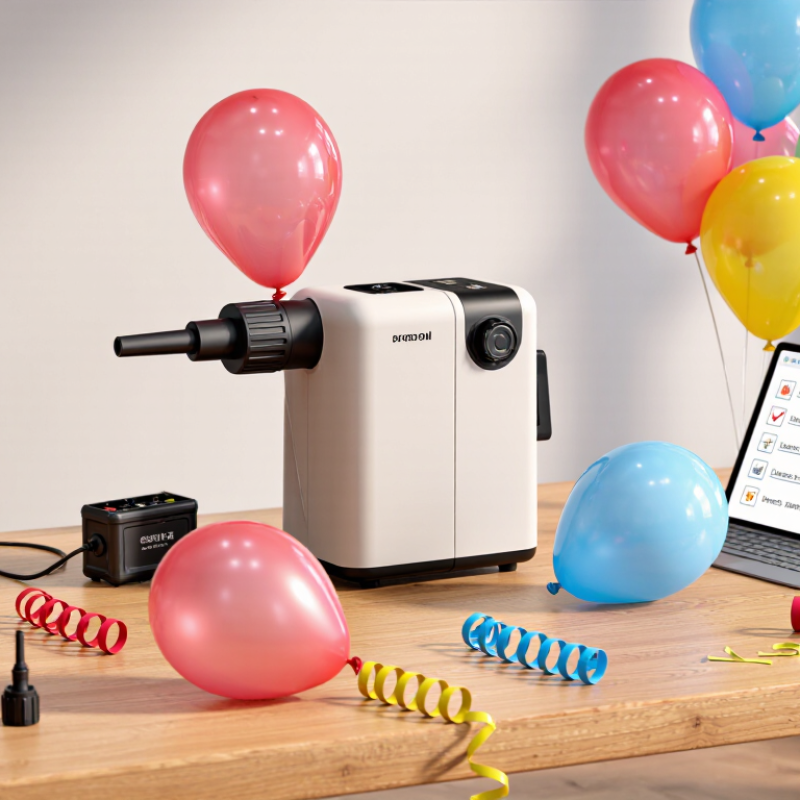
Before choosing an electric balloon pump, define the job it needs to do. A quiet pump for a small birthday table has different demands from one serving a school fair. Estimate the number of balloons, their sizes, and how quickly they must be ready. Preparing 80 standard balloons at home may call for a compact unit with simple controls. A busy decorating team may need a stronger motor and planned cooling breaks. Count carefully. The required pace is easy to underestimate.
Check where setup will happen. A wall outlet, extension lead, table space, and nearby storage can shape your choice as much as speed. If decorations are assembled on-site, consider the pump’s weight, cord length, and stability on the work surface. Think about who will use it. A volunteer should be able to understand its controls without a long lesson. Match the airflow and nozzle to the balloon types you actually use; high output alone does not guarantee neat results. Test a few balloons before the event, noting the time, noise, and any heat buildup. Leave extra time, too. Delicate balloons can be harder to control at the fastest setting, and that detail is easy to miss.
| Event or Use Case | Typical Balloon Requirements | Pump Type to Consider | Features to Look For | Important Checks |
|---|---|---|---|---|
| Occasional home decorations | A small number of standard latex balloons for a party or celebration. | Compact, single-nozzle electric air pump. | Lightweight design, simple controls, stable base, and a nozzle that fits the balloons you use. | Check whether the pump is intended for air inflation and whether it has an automatic shutoff or requires continuous hand control. |
| Birthday parties and small gatherings | Several dozen latex balloons, possibly in different sizes. | Single- or dual-nozzle electric air pump. | Easy-to-use inflation controls and a practical balance of airflow, size, and storage needs. | A dual-nozzle design does not necessarily inflate two balloons at the same rate; follow the product instructions and avoid running the pump beyond its rated duty cycle. |
| Medium-sized events and balloon décor | Repeated inflation for garlands, arches, or other arrangements using many latex balloons. | Higher-capacity electric air pump, with one or two usable nozzles. | Comfortable operating setup, clear on/off controls, appropriate airflow, and stated limits for continuous operation. | Allow cooling breaks when required. Match the nozzle and inflation method to the balloon size; do not overinflate balloons. |
| Large events or frequent professional use | High-volume inflation across multiple setups or repeated work sessions. | Heavy-duty or commercial-use air pump selected for the workload. | Documented duty cycle, suitable motor rating, replaceable or compatible nozzles, and a stable design for regular use. | Review the manufacturer’s operating and cooling instructions. Consider power supply, noise, portability, and access to service parts. |
| Mixed balloon sizes | Different latex balloon sizes requiring consistent sizing for a coordinated display. | An air pump with controllable inflation or a separate sizing method. | Controls that allow the user to stop inflation at the desired size; a balloon-sizing tool can help standardize results. | Inflation time alone does not guarantee identical balloon sizes. Check each balloon and leave room for tying. |
| Foil or letter-shaped balloons | Foil balloons with self-sealing valves, which may need a narrow inflation tip. | A pump specifically compatible with the foil balloon valve, or the inflation method recommended by the balloon maker. | A suitably narrow nozzle and clear instructions for valve access and inflation. | Not every electric balloon pump fits foil valves. Inflate slowly and stop when the balloon is filled; excess pressure can damage seams. |
| Outdoor setup or on-site decorating | Inflation away from a convenient indoor work area. | A pump with a power source appropriate for the location. | Portable construction and clearly specified voltage or battery details, if applicable. | Check the required power supply and protect electrical equipment from moisture. Many plug-in pumps need a suitable mains outlet. |
| Helium-filled floating balloons | Balloons that need to float rather than be filled with ordinary air. | A helium cylinder and compatible regulator or filling equipment—not a standard electric air pump. | Equipment designed and rated for helium service, with safe cylinder handling instructions. | Most electric balloon pumps move ambient air and do not provide helium. Follow local rules and supplier guidance for compressed-gas cylinders. |
Estimate the total count before choosing a pump. Around 80 standard balloons may need only a compact unit. Large events require stronger airflow and cooling breaks. Counts are easy to underestimate.
Check the wall outlet, extension lead, table space, and storage area. A long cord helps when outlets sit behind crowded tables. The pump should remain stable during use. Small details matter.
Match the nozzle and airflow to your actual balloon types. High output does not always produce neat results. Delicate balloons may become difficult to control at maximum speed. Test several sizes first.
Yes, especially when tables and outlets are inconvenient. A compact pump with a stable handle is easier to carry. A weight below two kilograms may feel more manageable. Crowded venues change everything.
Choose clear speed controls with simple operation. Volunteers should understand the settings without a long lesson. Small switches can frustrate tired fingers or gloved hands. Simple is safer.
Inspect the casing, power socket, nozzle fit, and cooling vents. Look for accessible screws and replaceable filters when possible. Repairable parts may reduce unnecessary disposal. An IP rating helps, but it proves little alone.
Run a five-minute test before the event. Listen for rising noise or unusual heat. Wipe the nozzle after use, and keep dust away from vents. Let it cool when necessary.
A timer or automatic shutoff can reduce overinflation and simplify use. However, these features may inflate balloons more slowly. Read the manual, then test the feature yourself. Real events are messier.
Choosing the right Electric Balloon Pump begins with understanding your event needs, including the number, size, and type of balloons you plan to inflate. Consider whether you need a compact pump for occasional parties or a stronger model for large events. Compare different pump types, power sources, and inflation speeds to find one that matches your workload. A suitable pump should also offer compatible nozzles for various balloon openings, simple controls, and enough power to inflate balloons efficiently without unnecessary delays.
Noise level, safety features, portability, and durability are equally important. Look for a lightweight design that is easy to carry, stable during use, and simple to clean and maintain. Before making a final decision, balance performance with warranty coverage and overall price. The most expensive option is not always the best choice; the ideal Electric Balloon Pump should provide reliable operation, convenient handling, and good long-term value for your specific decorating needs.

 MOZEN