Choosing a Digital Ball Pump for global sourcing requires more than comparing prices and screen designs. Buyers should assess pressure accuracy, measurement units, inflation speed, battery capacity, charging options, and nozzle compatibility. A bright display is useful, but it cannot compensate for inconsistent readings. Numbers matter.
Start with the products your customers actually use. A pump for footballs may need different pressure settings and accessories than one marketed for basketballs or volleyballs. Ask suppliers for operating ranges, product dimensions, materials, warranty terms, and clear user instructions. Then test a sample with several balls. Compare its displayed readings with a reliable pressure gauge, and repeat the test after multiple inflation cycles. Check how warm the device becomes, whether the buttons are easy to use, and whether the included needles feel sturdy. Small details count.
Global sourcing also involves practical checks beyond the product itself. Confirm the minimum order quantity, production lead time, packaging options, spare-part availability, and inspection process. Request relevant test documentation, and verify that product and charging specifications suit your intended markets. Requirements can vary by destination, so confirm them before placing a large order. A polished sample can still disappoint. Supplier claims deserve verification, not automatic trust. Even a careful test may miss problems that appear after months of use. This guide explains how to compare specifications, assess supplier evidence, and make a more informed purchasing decision without treating any single feature as a guarantee of quality.
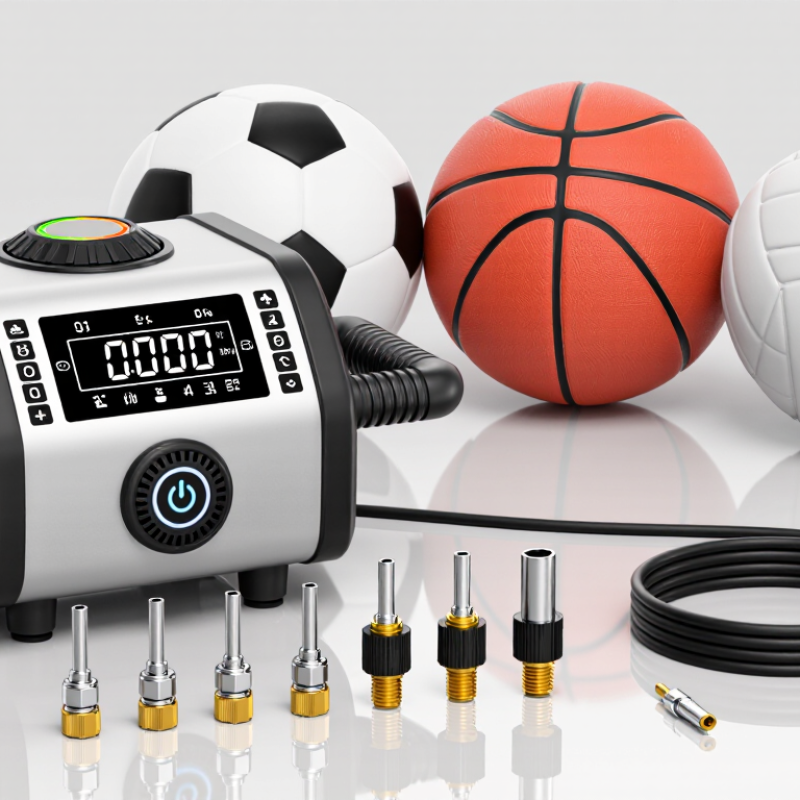
Define Performance and Compatibility Requirements
When choosing a digital ball pump for global sourcing, define performance requirements before comparing prices. A pump should match the pressure range of the target balls, from soft training balls to high-pressure sports balls. Specify inflation speed, pressure accuracy, noise level, and automatic shut-off behavior. A clear display helps users avoid overinflation. Small details matter.
Battery capacity also affects product reliability. Set a minimum operating time, charging duration, and expected battery life. Confirm whether the pump supports common charging inputs and regional electrical requirements. Check nozzle sizes, thread standards, and included adapters. Compatibility is often underestimated. A pump may work well in testing but fail with a different valve design. Request samples, technical drawings, user instructions, and test reports before placing a large order. Independent checks are useful when supplier data seems incomplete.
Tips:
Test the pump with real balls from several markets. Measure pressure with a separate calibrated gauge. Ask for performance results at low and high battery levels. Review drop, heat, and repeated-use tests. Specifications may look precise, yet actual performance can vary. That is uncomfortable, but useful. Leave tolerance ranges in the purchase agreement, because digital readings are not always perfectly consistent.
Compare Key Digital Ball Pump Specifications
How to Choose a Digital Ball Pump for Global Sourcing?
Global sourcing starts with measurable specifications, not attractive packaging. The SFIA 2024 Topline Participation Report recorded 242.3 million Americans participating in sports or fitness activities in 2023. That scale increases demand for reliable inflation tools. Compare pressure accuracy first. A digital pump showing PSI and kPa supports different markets and reduces training errors. For footballs, basketballs, and volleyballs, a practical range of 0–16 PSI covers most routine applications. However, maximum pressure alone can mislead buyers.
Check the pressure tolerance and auto-stop response. A pump rated at ±0.1 PSI sounds strong, but suppliers should request testing conditions and sample records. Small displays are difficult outdoors. A backlit screen helps. According to IEC 60529, an IP rating describes protection against dust and water, not overall durability. IPX4 may suit light splashes, while wet-field users should ask for higher protection. Do not treat the rating as magic.
Battery capacity also needs comparison. A 2,000–4,000 mAh lithium battery may support repeated inflation, but runtime depends on ball size, pressure, temperature, and motor load. USB-C charging improves sourcing flexibility across regions. Confirm charging input, cycle testing, needle storage, hose length, noise, and net weight. Keep spare needles included. They disappear easily. A 2023 Allied Market Research report identified convenience and portable design as major sporting-goods purchase factors, yet portability can reduce airflow and cooling. That trade-off deserves testing, not optimistic assumptions.
Evaluate Suppliers and Manufacturing Capabilities
When choosing a digital ball pump for global sourcing, supplier capability matters as much as product features. I begin by checking the factory’s production history, monthly capacity, and experience with pressure-sensitive devices. A supplier should explain its motor design, pressure sensor calibration, battery testing, and charging protection clearly. Vague answers are warning signs. Ask for proof.
Request samples from different production batches, not only a polished showroom unit. Test inflation speed, target-pressure accuracy, noise, heat, and battery endurance. I often record the pressure after ten minutes and repeat the test on footballs, basketballs, and volleyballs. Small errors matter. The display may show the correct number while the ball feels underinflated. That difference needs investigation.
Manufacturing reliability depends on process control. Check whether incoming components are inspected and whether each pump receives functional testing before packing. Review assembly instructions, defect records, corrective actions, and traceability labels. A factory audit should include the battery area, soldering stations, calibration tools, and finished-goods warehouse. Ask how the supplier handles failed samples and replacement parts. Some factories promise fast delivery but rely heavily on manual rework, which can create inconsistent quality. I have also seen inspection reports that looked complete but lacked test dates and operator signatures. That should not end the discussion, but it deserves a second audit. Clear specifications, retained samples, and written approval points make supplier evaluation more dependable.
Verify Quality, Safety, and Export Compliance
Choosing a digital ball pump for global sourcing requires more than checking pressure accuracy. Inspect the motor, display, valve adapters, battery compartment, and charging port. A loose connector may pass a showroom test but fail after repeated vibration. Ask for a production sample, not only a polished prototype. Test inflation speed, pressure deviation, noise, heat, and automatic shutoff. I would also repeat the test after 50 to 100 cycles. A perfect sample proves little.
Safety documents deserve careful review. For rechargeable models, request lithium-cell test evidence, UN 38.3 transport documentation, and applicable electrical and electromagnetic compatibility reports. Confirm RoHS and REACH declarations for the destination market. Do not treat a CE mark as proof by itself. The European Commission’s Safety Gate reports repeatedly identify electrical products as a significant product-safety category. That should encourage independent laboratory testing, not rushed approval. Check insulation, overheating protection, charger quality, and accessible moving parts. Small details matter.
Export compliance also includes accurate labeling, manuals, customs codes, battery declarations, and traceable carton markings. UNCTAD’s Review of Maritime Transport reports that over 80% of global merchandise trade by volume moves by sea, so packaging and documentation must survive long logistics chains. The OECD Trade Facilitation Indicators 2022 estimates that stronger border procedures can reduce trade costs by up to 14.3%. That figure supports disciplined paperwork. Still, requirements vary by country, and I would verify them with a qualified compliance specialist. A supplier’s confidence is not evidence. Test the details.
Assess Total Landed Cost and Sourcing Risks
How to Choose a Digital Ball Pump for Global Sourcing?
Total landed cost starts before the factory quote. Include tooling, inspection, export packing, freight, insurance, duties, brokerage, and inland delivery. Digital pumps may also require batteries, chargers, sensors, and replacement seals. Small costs compound. UNCTAD’s Review of Maritime Transport 2023 states that ships carry over 80% of global trade by volume. Therefore, freight delays can affect inventory financing and launch schedules. Request carton dimensions, gross weight, shipping terms, and a realistic production lead time. A cheap unit price can become expensive after customs and local handling charges.
Sourcing risk also needs a measurable review. The World Bank’s Logistics Performance Index 2023 compares 139 economies across customs, infrastructure, shipment reliability, and logistics competence. Use these factors when comparing production locations, not just labor costs. Check electrical safety, electromagnetic compatibility, battery transport documents, labeling, and destination-market requirements. Requirements vary by market. Keep test reports tied to the exact model and revision. A practical mistake is testing one sample, then accepting cheaper components later. That weakens reliability. Ask for pre-shipment inspections, production records, and a small spare-parts plan. Calculate landed cost again using three scenarios: normal freight, delayed freight, and a two-percent defect rate. My first spreadsheet once ignored return shipping. It looked precise, but it was incomplete. That lesson remains uncomfortable. Supplier concentration, currency movement, and port disruption should also receive a monetary value, even when the estimate feels imperfect.
FAQS
A 0–16 PSI range covers routine inflation for footballs, basketballs, and volleyballs.
Check PSI and kPa displays, stated accuracy, and auto-stop response. Request test conditions and sample records.
A backlit screen is easier to read outdoors. IPX4 may handle light splashes, but it does not prove overall durability.
Compare 2,000–4,000 mAh options, then test runtime with different ball sizes and pressures. Temperature and motor load matter too.
Confirm USB-C charging, hose length, noise, net weight, and needle storage. Include spare needles. They disappear easily.
Include tooling, inspection, packing, freight, insurance, duties, brokerage, and inland delivery. Small costs compound.
Review customs, infrastructure, shipment reliability, and logistics competence. Also check destination-market requirements and match test reports to the exact model revision.
Request pre-shipment inspections and production records. Test the delivered model, not just an early sample. Cheaper components may change the result.
Compare normal freight, delayed freight, and a two-percent defect rate. Include return shipping; I once missed it, and the estimate looked precise but was incomplete.
Conclusion
Choosing the right Digital Ball Pump for global sourcing requires a structured evaluation of both product performance and supplier reliability. Begin by defining the intended use, inflation speed, pressure range, power source, battery life, nozzle compatibility, portability, and operating environment. Then compare key specifications across available models, paying attention to measurement accuracy, charging options, noise level, durability, ease of operation, and adaptability to different ball types.
Supplier assessment should include manufacturing experience, production capacity, quality-control procedures, customization options, and communication efficiency. Buyers should also verify product safety, electrical testing, packaging standards, labeling, and export documentation for the destination market. Finally, calculate the total landed cost, including unit price, tooling, packaging, freight, duties, inspection, and possible warranty expenses. Reviewing lead times, minimum order quantities, payment terms, supply continuity, and contingency plans will help reduce sourcing risks and support a dependable long-term purchasing decision.

 MOZEN