China Top Sports Ball Pump Manufacturers for Global Buyers

Time:2026-09-20 Author:Madeline
0%

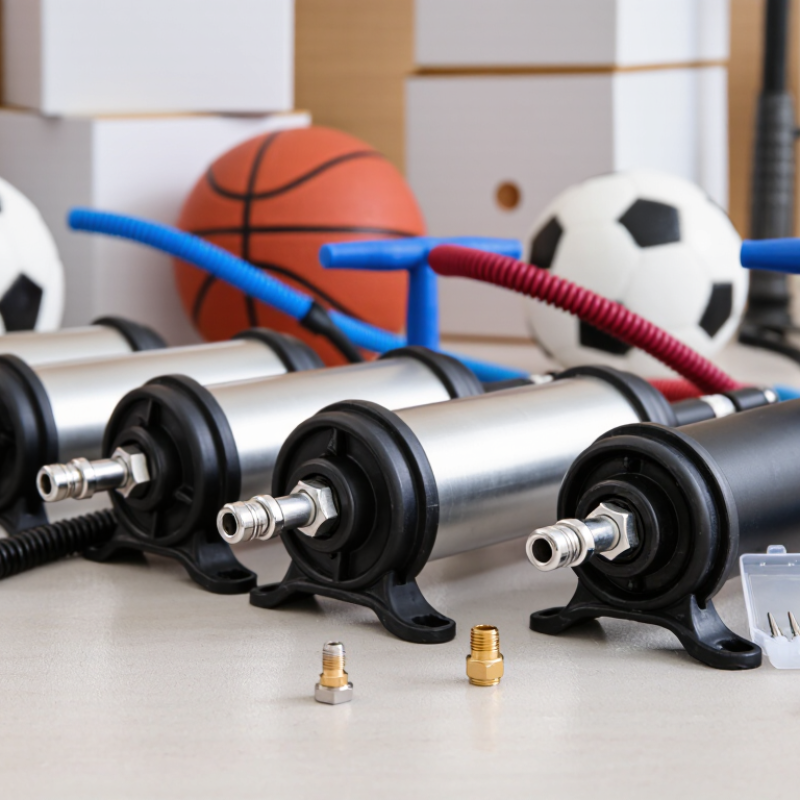
China Top Sports Ball Pump Manufacturers for Global Buyers is a practical guide for importers, distributors, and sporting-goods brands. Choosing a reliable Sports Ball Pump supplier involves more than comparing prices. Buyers should examine production experience, material consistency, testing procedures, and export communication. A pump may look strong in a product photo, yet its needle thread or hose connection can fail after repeated use.

This guide focuses on manufacturers that serve international markets and understand different ball categories, including footballs, basketballs, volleyballs, and training equipment. It considers pump pressure, grip comfort, valve compatibility, packaging quality, and replacement-needle availability. Factory audits, sample testing, and clear technical documents can reveal valuable differences. Ask for quality records, product specifications, and evidence of responsible manufacturing practices. Do not rely on attractive catalogs alone.

Small details matter. A smooth handle reduces hand fatigue during school training sessions. A reinforced hose can prevent leakage beside a busy sports field. However, supplier evaluation is never perfectly predictable. Samples may perform well while larger batches show minor variation. That possibility deserves attention. Buyers should define inspection standards before production and keep communication records throughout the order. This approach supports informed purchasing, safer product use, and stronger long-term partnerships. The best manufacturer is not always the cheapest. It is the supplier that can explain its process, acknowledge limitations, and improve when problems appear. Reliability grows through verification, not promises.
China Top Sports Ball Pump Manufacturers for Global Buyers

Product Scope: Hand, Foot, and Electric Pumps for Major Ball Sports

China Top Sports Ball Pump Manufacturers for Global Buyers

Hand, foot, and electric pumps serve different buying conditions. Hand pumps are compact and reliable for football, volleyball, and basketball maintenance.

Foot pumps provide better stability and faster inflation for clubs, schools, and retail counters. Electric pumps suit high-volume training centers, although battery life and noise require careful testing.

The 2024 SFIA Topline Participation Report recorded 242.6 million U.S. participants in sports and fitness activities during 2023. That scale supports steady demand for practical inflation equipment.

Pressure accuracy matters more than appearance.

FIFA Laws of the Game specify football pressure between 8.5 and 15.6 psi at sea level. FIBA rules set basketball pressure at 7.5 to 8.5 psi. Volleyball regulations require approximately 4.26 to 4.61 psi, according to official FIVB standards.

Buyers should request calibration records, valve compatibility tests, and cycle-life results. A metal needle helps. However, it can still bend during shipping. This detail is easy to overlook.

Tips:

Match pump output to the sport, not the package size. Ask for adapters, spare needles, carton drop-test results, and multilingual instructions.

For electric models, check charging standards and automatic shutoff accuracy. A supplier may claim universal compatibility, but field testing can reveal leakage, weak seals, or confusing gauges.

Small samples often expose larger problems.

Pressure Benchmarks: FIFA 0.6–1.1 atm, FIBA 7.5–8.5 psi, FIVB 4.3–4.6 psi

China Top Sports Ball Pump Manufacturers for Global Buyers

Pressure accuracy matters more than appearance when sourcing sports ball pumps. FIFA footballs typically require 0.6–1.1 atm, depending on competition rules and ball specifications. FIBA basketballs generally need 7.5–8.5 psi. FIVB volleyballs use a narrower range of 4.3–4.6 psi. These figures are not interchangeable.

A reliable manufacturer should provide pumps with readable, tested gauges and compatible needle valves. During factory evaluation, buyers should test several units, not only one sample. Check pressure readings against a calibrated reference gauge. Inspect the needle thread, hose connection, piston seal, and handle strength. Small leaks can create large measurement errors. Very annoying.

Temperature and altitude can also affect pressure readings. A ball tested in a warm warehouse may feel different on a cold outdoor court. Experienced suppliers should explain their testing conditions and provide inspection records. However, paperwork alone is not enough. Ask for repeated pressure tests across multiple production batches.

I have found that compact pumps are convenient, but their built-in gauges may be less stable. A separate gauge can improve verification, especially for tournament supply contracts. Still, every gauge can drift over time. That detail deserves attention. Buyers should request calibration intervals, replacement needles, and clear packaging instructions. A practical pump is not merely easy to carry; it must help users reach the correct pressure without guesswork.

China Top Sports Ball Pump Manufacturers for Global Buyers

The chart compares official inflation-pressure benchmarks in PSI. FIFA specifies 0.6–1.1 atm for footballs, equivalent to approximately 8.8–16.2 psi using 1 atm = 14.696 psi. FIBA specifies 7.5–8.5 psi for basketballs, while FIVB specifies 4.3–4.6 psi for indoor volleyballs.

China Supplier Screening: OEM/ODM, ISO 9001, and AQL 1.5 Quality Controls

China’s sports ball pump manufacturers serve global buyers through OEM and ODM programs. Yet supplier screening should begin with evidence, not attractive catalogs. ISO’s ISO Survey 2022 recorded more than 1.2 million ISO 9001 certificates worldwide, showing the standard’s broad industrial use. Certification alone proves little, however. Buyers should verify the certificate scope, factory address, audit status, and production processes.

A reliable factory should convert drawings into controlled samples, material specifications, and inspection points. Ask for records covering valve fit, needle straightness, hose flexibility, pressure performance, printing accuracy, and carton drop testing. For OEM projects, confirm who owns the mold, artwork, and technical files. ODM buyers should review previous development samples and revision histories. Small details matter.

AQL 1.5 needs careful interpretation. Under ISO 2859-1 sampling practice, it is an acceptance limit for a defined inspection plan, not a promise of only 1.5% defects. The purchase contract should identify lot size, sample quantity, critical defects, major defects, and minor defects. Inspectors should photograph sealed cartons and tested samples before shipment. Independent testing helps.

In practice, some suppliers present clean documents but weak traceability. That is a real warning. A factory audit should compare warehouse labels, batch records, and final inspection reports. I would also repeat testing after packaging changes. This step costs time, but skipping it can expose hidden failures.

China Top Sports Ball Pump Manufacturers for Global Buyers - China Supplier Screening: OEM/ODM, ISO 9001, and AQL 1.5 Quality Controls
Anonymous supplier-screening comparison for sports ball pumps. Commercial terms and compliance documents should be verified by the buyer before order placement.
Supplier ID Primary Product Scope OEM / ODM Capability ISO 9001 Evidence Incoming & Final QC Target AQL Standard Typical MOQ Range Export Documentation Sample Lead Time Screening Status
Supplier 01 Needle-inflation hand pumps for soccer, basketball, volleyball and rugby balls Custom color, logo, handle shape and retail packaging; tooling review required for new molds Certificate copy required Material inspection, air-leak test, needle fit test and appearance inspection AQL 1.5 for major defects; AQL 4.0 for minor defects, subject to purchase agreement 1,000–3,000 units Commercial invoice, packing list, carton details and origin information available upon request 7–12 working days Verify
Supplier 02 Double-action pumps with flexible hoses and universal inflation needles Private-label packaging, color matching and accessory combinations; ODM drawing approval required Validity and scope required Plastic-component inspection, hose connection test, pressure-holding test and carton drop test AQL 1.5 for critical and major defects according to approved inspection plan 2,000–5,000 units Invoice, packing list, HS-code support and pre-shipment inspection records 10–15 working days Verify
Supplier 03 Compact portable pumps for team kits, schools, clubs and promotional programs Logo printing, retail card, polybag and bundled needle options; artwork approval required Audit report required Sampling inspection for dimensions, pump stroke, needle threading and surface defects AQL 1.5 major / AQL 2.5 minor, unless a stricter buyer specification is agreed 3,000–10,000 units Commercial invoice, packing list, product description and shipping marks 5–10 working days Verify
Supplier 04 Heavy-duty floor pumps with pressure gauges for training facilities and sports retailers Handle, base, hose, gauge and packaging customization; prototype confirmation recommended Certificate and audit date required Gauge accuracy check, pressure retention, base stability, hose fatigue and packaging inspection AQL 1.5 for major defects with defined gauge-accuracy tolerance 500–1,500 units Invoice, packing list, carton specifications and inspection certificate when requested 12–20 working days Verify
Supplier 05 Mini pumps and replacement inflation-needle sets for online and retail channels Custom color, laser marking, barcode label and multi-piece set packaging Current certificate required Needle straightness, thread compatibility, air-flow test, labeling and quantity verification AQL 1.5 for major defects; sampling level to be stated on the inspection order 1,000–5,000 sets Invoice, packing list, package dimensions and product-material declaration 6–10 working days Verify
Supplier 06 Multi-sport pump kits including pump body, hose, needles and adaptors Full OEM/ODM development, accessory selection and multilingual packaging support Third-party validation required Bill-of-material verification, accessory count, leak test, assembly inspection and carton audit AQL 1.5 for major defects; critical safety-related defects require zero acceptance 1,000–3,000 kits Invoice, packing list, origin information, product specification and inspection report 10–18 working days Verify
Buyer verification checklist: Confirm the legal manufacturing entity, current ISO 9001 certificate and scope, factory audit results, approved sample, material specifications, packaging artwork, production capacity, inspection level, AQL acceptance criteria, corrective-action process and pre-shipment inspection records before issuing a purchase order.

Technical Comparison: Airflow, Hose Design, Needle Fit, and Cycle-Life Tests

For global buyers, pump performance should be tested against real ball-pressure requirements. FIFA Laws of the Game specify 0.6–1.1 atmospheres at sea level, while World Rugby requires 65.5–68.5 kPa. These figures expose weak airflow claims quickly. A reliable test records pressure gained per 20 strokes, using the same ball, needle, and temperature. Stroke efficiency matters more than advertised cylinder volume. Small differences become tiring during tournament preparation.

Hose design deserves closer inspection. A short, flexible hose reduces bending losses and protects the valve from side loading. However, an overly narrow hose can restrict airflow.

Needle fit is equally practical: the needle should enter smoothly, remain centered, and seal without leakage. ISO 20957 testing principles support repeatable mechanical loading, but they do not define every sports-pump requirement.

Buyers should therefore add a needle-insertion test and a 90-degree hose-flex test.

Cycle-life testing should combine full strokes with realistic pauses. A useful procurement protocol may test 5,000 cycles, then measure airflow, handle play, hose cracks, and thread wear. Some pumps survive laboratory cycling but fail after dusty field use. That is a gap worth admitting. Results should include failure rates, not only average performance. Independent laboratory reports, calibration records, and batch samples strengthen supplier claims. A single impressive prototype proves very little.

Global Purchasing: MOQ, Incoterms, CE/RoHS Files, and HS Code 8414.20

China Top Sports Ball Pump Manufacturers for Global Buyers

Global purchasing starts with a clear MOQ discussion. Many factories quote different quantities for standard pumps, custom colors, and printed packaging. Request sample pricing before confirming volume. A practical order may begin with 500 or 1,000 pieces, but the real MOQ depends on materials, tooling, and packaging. Ask whether spare needles, cartons, and inspection costs are included. Small details become expensive later.

Incoterms must match your logistics experience. EXW may offer a lower price, but your team manages inland transport and export procedures. FOB usually gives better control at the departure port. CIF can simplify ocean freight, yet destination charges remain uncertain. DDP sounds convenient, but confirm who handles import taxes and local compliance. Get every charge written into the quotation. Verbal promises are weak evidence.

For customs planning, HS Code 8414.20 commonly covers hand- or foot-operated air pumps. Classification can vary with design, materials, and destination-country interpretation. Confirm it with a licensed customs broker before shipment. Request technical drawings, product specifications, packing details, and a commercial invoice draft. CE and RoHS files also need careful review. A manual pump may not require the same documentation as an electric model. CE marking is not a universal quality certificate. RoHS relevance depends on electrical and market requirements. Check test reports, declarations, and document consistency. Errors happen. Review them before production, not at the port.

FAQS

Which pump type suits different sports and users?

Hand pumps are compact for football, volleyball, and basketball maintenance. Foot pumps offer better stability and faster inflation. Electric pumps fit busy training centers. Pressure matters more.

What pressure should buyers check for sports balls?

Footballs generally require 8.5–15.6 psi at sea level. Basketballs commonly require 7.5–8.5 psi. Volleyballs need approximately 4.26–4.61 psi. Always confirm the relevant sport rules.

What should buyers test before placing a large order?

Request samples, calibration records, valve tests, and cycle-life results. Check leakage, hose flexibility, gauge clarity, and needle alignment. Test it yourself. A clean catalog proves little.

Are electric pumps always the fastest choice?

Electric pumps can support repeated inflation at busy facilities. However, battery life, charging compatibility, noise, and automatic shutoff need testing. A quiet pump may still inflate slowly.

How can buyers evaluate a factory’s quality system?

Verify certification scope, factory details, audit status, and production records. Review inspection points for valves, needles, hoses, pressure, printing, and cartons. Documents can mislead.

What does an AQL 1.5 requirement actually mean?

AQL 1.5 describes an acceptance limit within a defined sampling plan. It does not guarantee only 1.5% defective products. Define lot size, sample quantity, and defect levels in writing.

What should an OEM or ODM contract clarify?

Confirm ownership of molds, artwork, drawings, and technical files. Review development samples and revision histories. Ask who pays for changes. This detail is easy to overlook.

What purchasing details should international buyers confirm?

Confirm MOQ, sample costs, spare needles, packaging, inspection fees, and shipping charges. Compare EXW, FOB, CIF, or DDP responsibilities carefully. Verbal promises are weak evidence.

What documents help with customs and product compliance?

Request technical drawings, specifications, packing details, and a commercial invoice draft. Confirm the tariff classification with a licensed customs broker. Electric models may require additional documentation. Check everything before production.

Conclusion

For global buyers, a Sports Ball Pump supplier should offer a practical range of hand, foot, and electric pumps for footballs, basketballs, volleyballs, and other major sports balls. Product evaluation should consider target pressure requirements, including FIFA’s 0.6–1.1 atm, FIBA’s 7.5–8.5 psi, and FIVB’s 4.3–4.6 psi benchmarks. Key technical factors include airflow efficiency, durable hose construction, secure needle compatibility, ergonomic operation, and cycle-life performance under repeated use.

A reliable China supplier should also support OEM and ODM projects, maintain ISO 9001 quality systems, and apply AQL 1.5 inspection controls. Before purchasing, buyers should confirm MOQ, Incoterms, production lead times, packaging, and available CE/RoHS documentation. Correct product classification, including HS Code 8414.20 where applicable, can help streamline customs preparation. Comparing samples and reviewing pressure testing, leakage checks, and accessory fit before mass production can further reduce quality and delivery risks.

Madeline

Madeline

Madeline is a dedicated marketing professional with a wealth of expertise in our company's core offerings. With a keen understanding of the industry, she brings a unique perspective to her role, consistently delivering high-quality content that highlights the superior aspects of our products. As......